




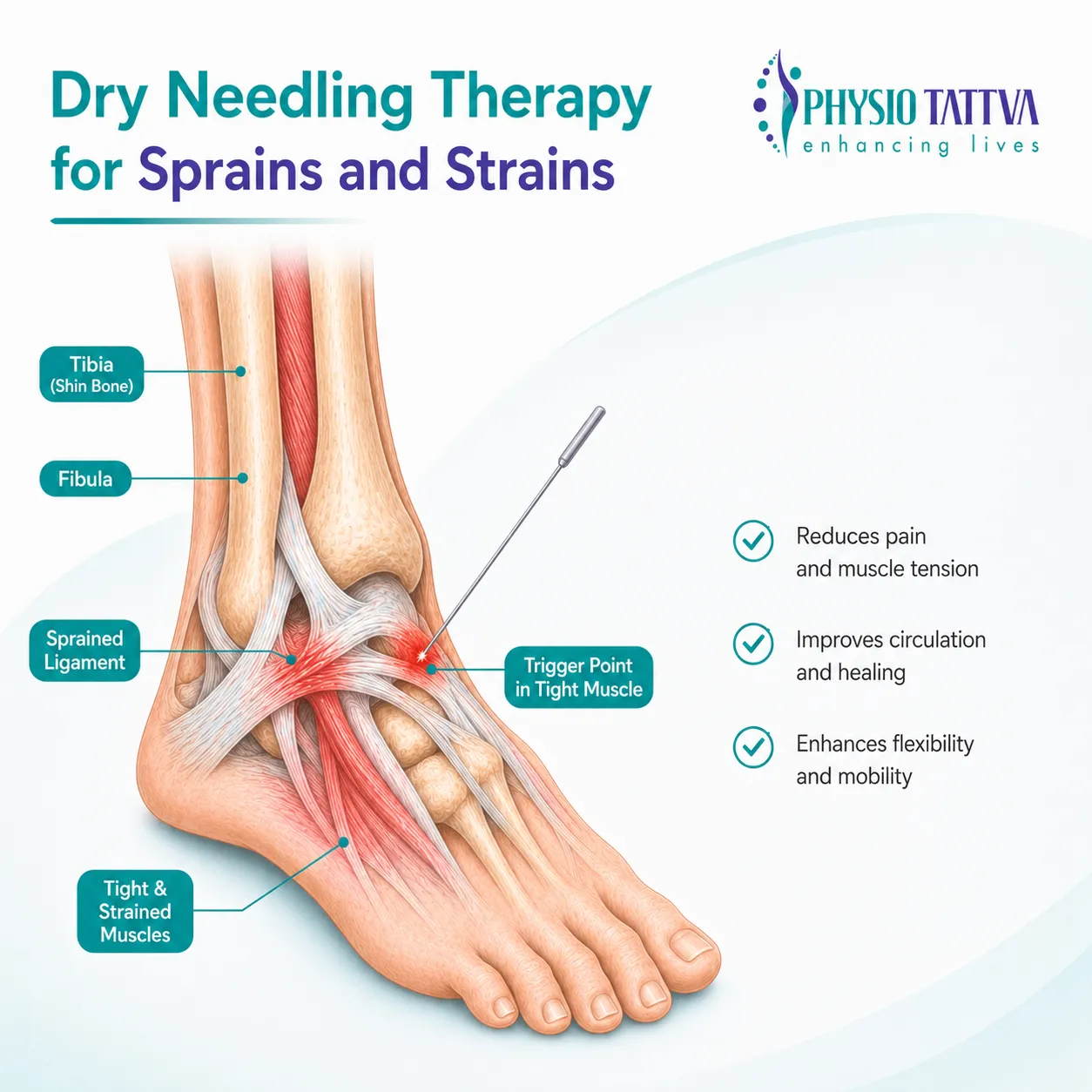
Dry needling therapy for sprains and strains is used to release tight and painful muscles that often develop around an injured ligament, tendon, or muscle. By targeting trigger points with very thin sterile needles, the treatment helps reduce muscle guarding, ease pain, and improve movement around the injured area. It is commonly used as part of a broader physiotherapy rehabilitation plan that includes strengthening, mobility work, and guided exercises. While dry needling does not directly repair the sprain or strain itself, it can make recovery exercises more comfortable and support smoother rehabilitation progress after injury.
What Is Dry Needling Therapy for Sprains and Strains?
Dry needling therapy for sprains and strains is a physiotherapy technique used to treat tight, painful muscles that often develop around an injured area after a ligament, muscle, or tendon injury. It involves placing very fine sterile needles into specific muscle points to address guarding, tension, and movement restriction that can slow rehabilitation.
Some key characteristics of this treatment include:
- Muscle-focused approach: It is used to target tight and sensitive muscles around the injured area.
- Uses fine sterile needles: The needles are very thin, single-use, and no medicine is injected through them.
- Targets trigger points: It is often used on tight muscle points that may be adding to pain and restricted movement after injury.
- Used in physiotherapy care: It is usually part of a broader rehab plan for sprains and strains rather than a standalone treatment.
How Does Dry Needling Therapy for Sprains and Strains Work?
After a sprain or strain, the injured area often becomes painful, swollen, and stiff, and the surrounding muscles may tighten to protect it. Dry needling treatment for sprains and strains is used to address the muscle guarding and tension, so recovery work can move forward more comfortably.
Here is how the process usually works:
- The injured area is assessed first: The physiotherapist checks pain, swelling, movement limits, and the surrounding muscle tightness before planning treatment.
- Tight muscle points are identified: The focus is usually on trigger points or guarded muscles around the injured ligament, muscle, or tendon.
- A fine needle is placed into the selected muscle: Very thin sterile needles are inserted into the target muscle points.
- The muscle may give a local response: In some cases, the muscle may briefly twitch or feel sore when the trigger point is reached.
- The area is then allowed to settle: Once the needle is removed, the muscle may gradually feel less tense or less sensitive.
- The treatment is usually followed by rehab work: Dry needling is often combined with movement work, strengthening, and physiotherapy exercises to support recovery.
What Sprains and Strains Can Dry Needling Therapy Be Used For?
Dry needling is not limited to one body part. It may be considered when a sprain or strain is followed by persistent muscle tightness, guarding, or trigger point pain that is making movement harder.
It may be used in cases such as:
- Dry needling for ankle sprain: It may be used when ankle sprain is followed by tightness in the calf, peroneal, or surrounding supporting muscles.
- Dry needling for muscle strain: It may be considered for strains involving areas such as the hamstring, calf, groin, neck, shoulder, or low back when muscle tension remains high.
- Knee and wrist sprains: It may be used when nearby muscles have become tight and painful after ligament injury.
- Shoulder and upper-body strains: It may be considered when shoulder, chest, or upper-back muscle tightness is limiting comfortable movement.
Benefits of Dry Needling Therapy for Sprains and Strains
When muscle guarding and tightness continue after an injury, dry needling is often used to address that muscular tension as part of a wider rehab plan. The main benefits are usually linked to pain relief, muscle release, and better movement comfort.
- Helps ease pain: It is often used when tight surrounding muscles are adding to discomfort after a sprain or strain.
- Reduces muscle guarding: It helps release protective tightness that can develop around an injured area.
- Improves movement comfort: Many patients find that walking, reaching, bending, or using the injured area feels easier after treatment.
- Supports rehab progress: It is often used to make mobility work, strengthening, and physiotherapy exercises more comfortable.
- Useful in lingering cases: It is often considered when pain and tightness continue even after the early injury stage has passed.
Who Is Not a Good Candidate for Dry Needling Therapy for Sprains and Strains?
Dry needling is not suitable for every case, so a physiotherapist should always decide this after proper assessment. The treatment may need to be avoided or used with extra caution when certain medical or safety concerns are present.
Dry needling may not be suitable in cases such as:
- Severe needle fear or anxiety: Patients who are extremely uncomfortable with needles may not tolerate the treatment well.
- Skin infection, irritation, or open wound near the area: Treatment is usually avoided if the tissue around the target area is not healthy.
- Bleeding disorders or blood thinner use: Extra caution is needed when there is a higher risk of bleeding or bruising.
- Pregnancy in certain situations: Dry needling may be avoided depending on the area being treated and clinical judgement.
- Active medical concerns that need review first: The physiotherapist may delay or avoid treatment if there are safety concerns that need further assessment.
How Long Does It Take to See Results from Dry Needling Therapy for Sprains and Strains?
Response time can vary depending on how recent the injury is, how much muscle guarding is present, and whether the sprain or strain is mild or more significant. Dry needling is not a one-step fix, but it can be used to make pain and movement restriction easier to manage during rehabilitation.
A few important points to know about timing:
- Some people notice short-term relief early: Pain or muscle tightness may feel better soon after a session in some cases.
- Movement change may take a little longer: Function usually improves gradually as pain settles and rehab progresses.
- Progress is often linked to combined treatment: Results are usually better when dry needling is paired with mobility work, strengthening, and guided physiotherapy.
- Recovery still depends on the injury itself: A sprain or strain still needs time to heal, so treatment is usually aimed at supporting comfort and progress rather than creating instant recovery.
Why Is Dry Needling Therapy for Sprains and Strains Often Combined with Other Treatments?
Dry needling is usually not used on its own for injury recovery. It is often included within a broader physiotherapy plan so that pain relief and reduced muscle guarding can be supported by movement correction, strengthening, and gradual return to activity.
It is commonly combined with treatments such as:
- Therapeutic exercise: Strengthening and mobility work to help the injured area regain control and function.
- Manual therapy: Hands-on techniques to improve joint and soft tissue movement around the injury.
- Load management: Guidance on walking, training, lifting, or sport-specific activity so the injured area is not overloaded too early.
- Supportive rehab advice: Taping, pacing, and movement modification depending on the type of sprain or strain.
Recover Smarter with Targeted Dry Needling Therapy at Physiotattva
Whether you're dealing with a pulled muscle or recovering from a ligament sprain, dry needling offers a focused and evidence-based solution to reduce pain, release tension, and accelerate healing. When performed by a trained physiotherapist, it can be a powerful tool to restore movement, improve circulation, and support a full return to activity. Consult your physiotherapy expert to explore how dry needling can complement your recovery plan and help you move better, faster.
At Physiotattva physiotherapy clinics in Bangalore and Hyderabad, you receive personalised care tailored to your specific needs, ensuring effective results and comfort throughout your journey to recovery.
Don’t wait to start your recovery! Get in touch with Physiotattva for more details! Contact us at +91 89510 47001.
Key Takeaways:
- Dry needling therapy for sprains and strains is used to target tight and painful muscles around an injured area.
- It helps reduce muscle guarding, improve movement comfort, and support rehabilitation progress.
- The treatment is usually brief and may cause mild temporary soreness after the session.
- It is generally used along with strengthening, mobility work, and other physiotherapy care.
- Suitability should always be decided after assessment, as dry needling may not be right for every sprain or strain case.
Why Physiotattva?
22+
50,000+
95%
200+
25+
4.8
Cities We Serve

Bangalore
At Physio Tattva, we are committed to bring access to quality physio care through ultra-modern clinics and high-skilled practitioners to all.
.webp)
Hyderabad
At Physio Tattva, we are committed to bring access to quality physio care through ultra-modern clinics and high-skilled practitioners to all.
.webp)
Vishakhapatnam
At Physio Tattva, we are committed to bring access to quality physio care through ultra-modern clinics and high-skilled practitioners to all.
Core Treatments
Core Conditions
Core Symptoms
Frequently Asked Questions
Is dry needling the same as acupuncture?

Can dry needling be combined with other treatments?
Does dry needling help with sprains?
Does dry needling help with strains?
How painful is dry needling?
How many sessions of dry needling are usually needed?
Are there any side effects of dry needling?






%20(1)-p-3200.jpeg)


.jpg)
.webp)
.webp)
.webp)