




.webp)
Physiotherapy Treatment for Back Pain
Determining the cause behind back pain is not enough, as you need to focus on multiple treatments and therapies to produce better results.
The debilitating pain of a herniated disc can turn your world upside down. Simple movements you once took for granted, like sitting at a desk, bending to tie your shoes, or even walking, can become sources of agonizing pain. Doctors often advise that exercise is crucial for recovery, but this presents a frustrating paradox: how can you exercise when the very act of moving hurts? Land-based exercises can be too jarring, putting stress on your spine and potentially worsening your condition.
This is where aqua therapy for a herniated disc emerges as a revolutionary solution. Imagine a supportive, gentle environment where you can move freely, strengthen your body, and begin to heal without the harsh strain of gravity. This article will explore how this form of hydrotherapy for disc bulge works, its specific benefits, and how you can start your recovery journey with the experts at Physiotattva.
Before diving into the solution, it’s helpful to understand what’s happening in your back. Think of your spine as a stack of bony blocks (vertebrae). Between each vertebra is a soft, shock-absorbing cushion called an intervertebral disc. These discs are like jelly-filled donuts, with a tough outer ring (annulus fibrosus) and a soft, gel-like center (nucleus pulposus).
A herniation, often called a slipped or ruptured disc, occurs when a tear in the tough outer ring allows some of the soft "jelly" to push out. This protruding material can then press on the sensitive spinal nerves nearby. This pressure is what causes the characteristic pain, numbness, tingling, or weakness, which can radiate down your leg—a condition commonly known as sciatica.
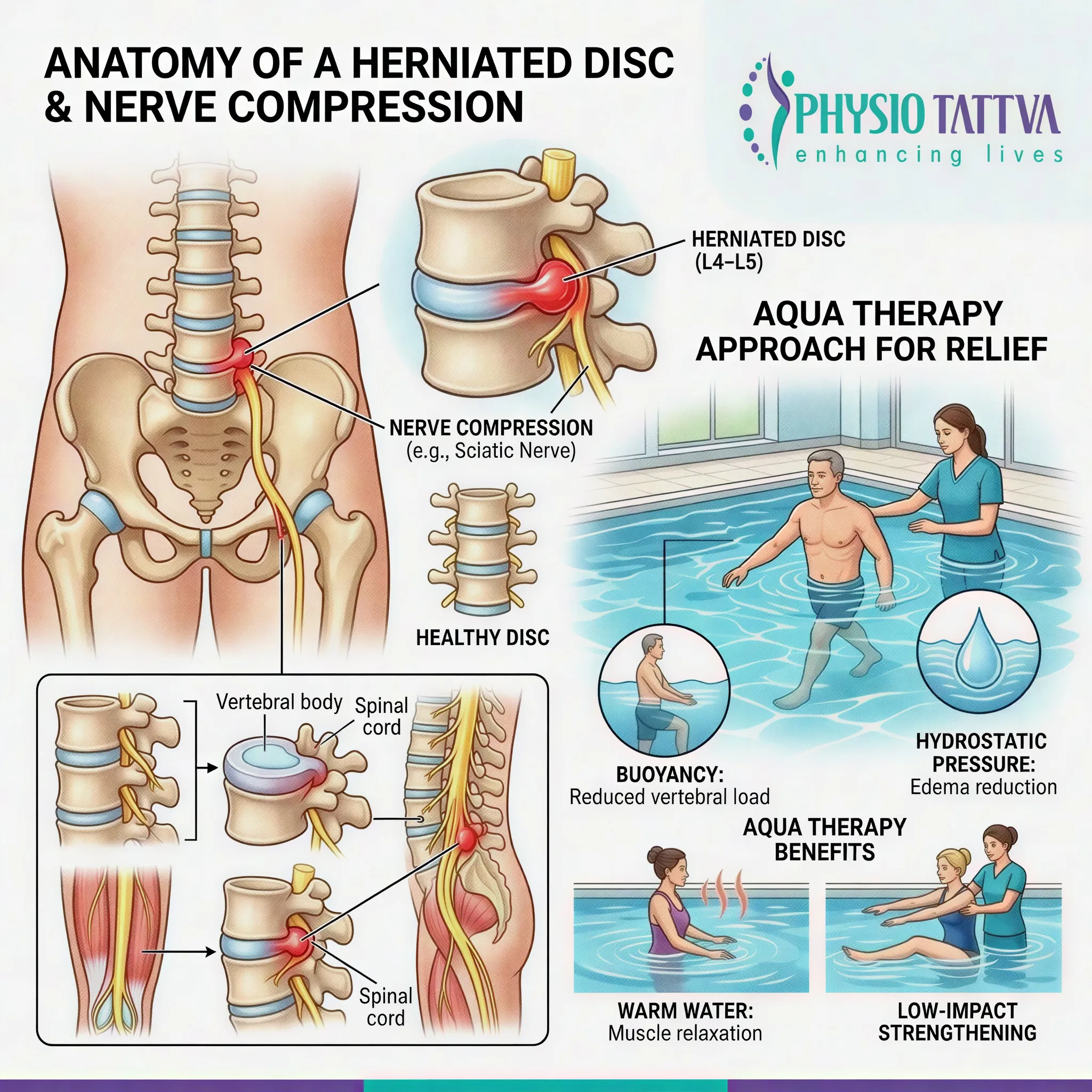
Water isn’t just for swimming; it’s a uniquely powerful medium for spinal rehabilitation. The science behind aquatic therapy for a slipped disc is based on four key principles that create the perfect environment for healing.
The most significant benefit of water is buoyancy. When you are submerged in chest-deep water, your body only bears about 10-20% of its weight. This buoyancy effectively counteracts gravity, lifting the compressive load off your vertebrae and discs. For someone with a herniated disc, this creates space in the spinal column, which can immediately reduce pressure on the impinged nerve and provide profound pain relief. This decompression allows you to move and exercise in ways that would be impossible on land.
Hydrostatic pressure is the gentle, consistent pressure that water exerts on your body from all sides. Think of it as a full-body compression sleeve. This constant pressure helps to reduce swelling (edema) around the injured disc and nerve root, a primary source of pain. It also improves blood circulation and lymphatic drainage, delivering essential oxygen and nutrients to the damaged tissues to accelerate the healing process. This makes water therapy for back pain incredibly effective at managing inflammation.
Moving through water provides a gentle, natural resistance that is far safer than using weights. This viscosity allows you to strengthen the deep core, back, and hip muscles that are essential for stabilizing and supporting your spine. Unlike land-based exercise, the resistance is uniform and applied in all directions, promoting balanced muscle development and preventing the jarring impacts that can aggravate a herniated disc. As you get stronger, you can increase the intensity simply by moving faster or using aquatic equipment.
Therapeutic pools used for physiotherapy for a herniated disc are typically heated to a comfortable temperature. This warmth works wonders for pain relief. It helps to relax tight, spasming muscles in the back and legs, increases the elasticity of connective tissues, and further enhances blood flow. The soothing effect of the warm water can decrease overall pain sensitivity, making it easier and more comfortable to perform therapeutic exercises.
While in the water, a physiotherapist will guide you through specific movements designed to promote healing and restore function.
Disclaimer: It is crucial that these exercises are performed under the supervision of a qualified physiotherapist, like the team at Physiotattva. They will ensure you use the proper form and tailor the program to your specific condition to prevent further injury.
A foundational exercise, walking forward, backward, and sideways in chest-deep water is a fantastic, zero-impact way to improve mobility. It gently engages your core muscles to maintain stability and improves cardiovascular health without any of the jarring stress of walking on pavement.
Holding onto the side of the pool for support, you can gently bring one knee toward your chest. The water’s buoyancy supports the weight of your leg, allowing for a safe and deep stretch of the lower back, glutes, and hamstrings. This helps relieve tension and improve flexibility without straining the spine.
Unlike a floor plank, which can put immense pressure on the spine, a pool plank is much gentler. You stand in the water and lean forward with your arms extended, pressing against the pool wall. This safely activates the deep core stabilizing muscles (like the transverse abdominis) that act as a natural corset for your spine.
Standing with your feet shoulder-width apart in the water, you can slowly rotate your upper body from side to side. The water's resistance forces you to move slowly and with control, preventing any sudden, jarring twists. This exercise is excellent for safely improving rotational mobility in the spine.
Aqua therapy is a versatile and highly beneficial treatment for a wide range of individuals, particularly:
Patients with acute pain from a herniated disc who find land-based exercise too painful to tolerate.
Individuals in the post-operative phase of spinal surgery who need a safe way to begin rehabilitation.
Those suffering from chronic low back pain or sciatica relief who require a low-impact exercise for back pain.
Patients with co-existing conditions like severe arthritis, fibromyalgia, or obesity that make weight-bearing activities difficult.
At Physiotattva, we believe that recovery should be empowering, not intimidating. Our approach to aqua therapy is not just about general exercise in a pool; it is a prescribed, evidence-based medical treatment. Our certified physiotherapists begin with a comprehensive assessment to understand your specific diagnosis, pain level, and functional goals. From there, they design a one-on-one, customized treatment plan just for you.
Whether you are seeking aqua therapy for a herniated disc or expert hydrotherapy for disc bulge, our state-of-the-art clinics are equipped with therapeutic pools and a dedicated team to guide your recovery. Don't let back pain control your life.
At Physiotattva physiotherapy clinics in Bangalore and Hyderabad, you receive personalised care tailored to your specific needs, ensuring effective results and comfort throughout your journey to recovery.
Don’t wait to start your recovery! Get in touch with Physiotattva for more details! Contact us at +91 89510 47001.

At Physio Tattva, we are committed to bring access to quality physio care through ultra-modern clinics and high-skilled practitioners to all.
.webp)
At Physio Tattva, we are committed to bring access to quality physio care through ultra-modern clinics and high-skilled practitioners to all.
.webp)
At Physio Tattva, we are committed to bring access to quality physio care through ultra-modern clinics and high-skilled practitioners to all.












%20(1)-p-3200.jpeg)

.jpg)
.webp)
.webp)
.webp)

