




A herniated disc can cause debilitating pain, numbness, and weakness that significantly impacts daily life. While treatments like physical therapy, medication, and sometimes surgery are common, many people seek complementary, non-invasive options for pain relief and functional support. Kinesio taping therapy has emerged as a popular and effective tool in this regard.
This article will break down how Kinesio taping therapy works for a herniated disc, its benefits, application techniques, and its role within a broader treatment plan.
What Is a Herniated Disc?
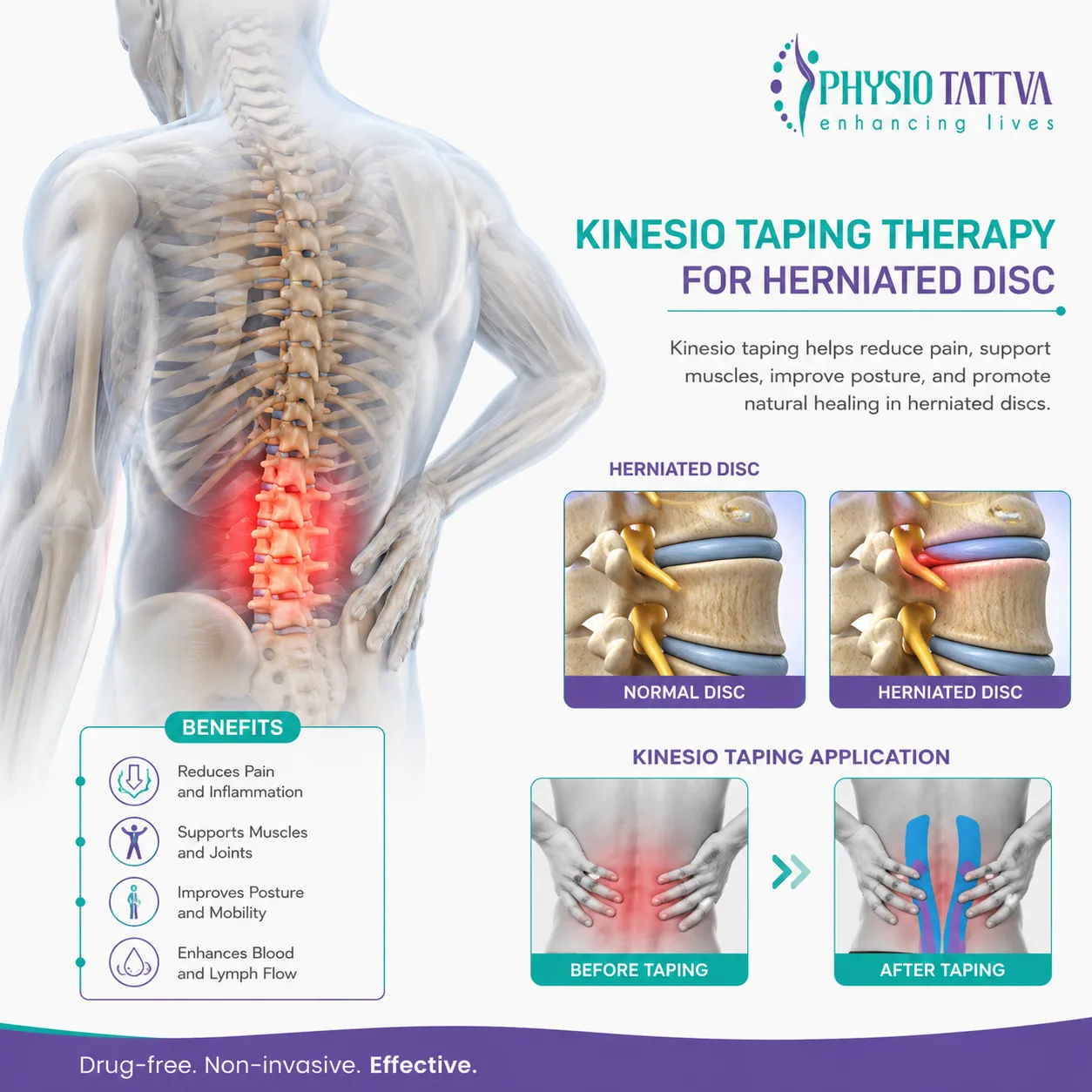
Think of the discs in your spine as small, jelly-filled doughnuts that sit between your vertebrae, acting as shock absorbers. A herniated disc (also called a slipped or ruptured disc) occurs when the soft, "jelly-like" centre (nucleus pulposus) pushes out through a tear in the tougher exterior (annulus fibrosus).
This herniated material can press on a nearby spinal nerve, leading to common symptoms:
- Pain: Localised pain at the site of the herniation (low back or neck) or radiating pain.
- Sciatica: Sharp, shooting pain that travels down the leg if the herniation is in the lower back (lumbar spine).
- Numbness or Tingling: A "pins-and-needles" sensation in the area the nerve serves.
- Weakness: Difficulty lifting an arm or leg, or experiencing "foot drop."
What is Kinesio Taping?
Kinesio Tape (or KT tape) is a therapeutic, elastic cotton tape with a medical-grade acrylic adhesive designed for pain management and movement support. Unlike rigid athletic tape that restricts or immobilises a joint, Kinesio tape mimics the natural elasticity of the skin, allowing a full and comfortable range of motion during daily activities and exercise. When applied correctly by a trained professional, the tape gently lifts the skin, creating a microscopic space between the skin and the underlying tissues. This decompressive effect can help reduce pressure, improve circulation, and support the body’s natural healing process without limiting movement.
How Kinesio Taping Therapy Helps a Herniated Disc
Kinesio taping is not a cure for a herniated disc and does not reposition the disc material itself. Instead, it serves as a supportive therapy that helps manage symptoms, reduce strain, and support the healing environment through the following mechanisms:
Pain Relief via Decompression and Sensory Input
This mechanism focuses on reducing pain perception and nerve irritation without restricting movement.
- The Theory: By lifting the skin, the tape creates a small amount of space, which can reduce pressure on the underlying pain receptors. More importantly, the constant gentle sensation from the tape on the skin sends signals to the brain that compete with the pain signals from the irritated nerve. This is based on the "Gate Control Theory of Pain," where non-painful stimuli can effectively "close the gate" to painful ones.
Muscle Support and Inhibition
Kinesio taping helps manage muscle imbalances that commonly develop alongside disc herniation.
- A herniated disc often causes protective muscle spasms and guarding. The surrounding muscles (like the erector spinae in the lower back) become overworked and tight.
- Kinesio tape can be applied to support these over-fatigued muscles, reducing their workload and allowing them to relax. Conversely, it can also be used to inhibit overactive muscles that are contributing to poor posture and strain.
Improved Circulation and Reduced Inflammation
This effect supports tissue recovery by improving fluid movement around the affected area.
- The lifting action of the tape enhances blood and lymphatic flow in the taped area.
- Improved circulation helps deliver oxygen-rich blood to the injured tissues and, more importantly, helps drain lymphatic fluid, which carries away metabolic waste and inflammatory byproducts. This can help reduce swelling and localised inflammation around the nerve root.
Proprioceptive Feedback and Postural Correction
Kinesio taping also plays a role in improving movement awareness and posture.
- Proprioception is your body's awareness of its position in space. The tape on your skin provides a constant reminder that encourages you to maintain better posture and avoid movements that aggravate the disc.
- For example, if you start to slouch, the gentle pull of the tape on your back skin will cue you to sit up straight, preventing further strain on the lumbar or cervical spine.
Common Application Techniques for Herniated Discs
Kinesio taping techniques for herniated discs are designed to support the spine, reduce muscular strain, and provide pain-relieving sensory feedback. However, the exact taping approach varies depending on the location of the disc herniation and individual symptoms. The examples below outline commonly used techniques for the lower back and neck.
Important Disclaimer: These techniques are provided for educational purposes only. For safety and optimal results, Kinesio taping should always be applied by a qualified physical therapist, chiropractor, or trained healthcare professional who has accurately assessed and diagnosed your condition.
For a Lumbar (Low Back) Herniated Disc
This is often associated with sciatica. A common goal is to decompress the lumbar spine and support the erector spinae muscles.
- Decompression "Star" or "Fan": The patient bends forward slightly to stretch the skin. Several strips of tape are applied over the point of maximum pain, often L4-L5 or L5-S1, in a star or asterisk pattern. The center of each strip has moderate stretch, with no stretch on the ends. This technique aims to lift the skin directly over the affected area.
- Spinal Muscle Support: Two long strips ("I" strips) are applied on either side of the spine, running parallel to the erector spinae muscles from the top of the pelvis up to the mid-back. These are applied with light stretch to provide support and proprioceptive feedback.
For a Cervical (Neck) Herniated Disc
The goal is to support the neck muscles (like the trapezius and levator scapulae) and reduce strain.
- Muscle Support: The patient gently tilts their head forward and to the side. A "Y" strip or two "I" strips are applied from the base of the skull or side of the neck down toward the shoulder blade. This helps offload the neck extensors and trapezius muscles.
- Anterior Decompression: A decompression strip can be carefully applied to the front or side of the neck if there is radiating pain into the arm, but this is an advanced technique that requires professional application due to the sensitive structures in the neck.
Supporting Recovery with Kinesio Taping with Physiotattva
Living with a herniated disc can be physically and mentally exhausting, especially when pain interferes with everyday movement and comfort. While Kinesio taping therapy does not treat the disc itself, it plays a valuable role in managing symptoms by reducing pain, supporting strained muscles, and encouraging better posture and movement patterns. When used correctly, it can make daily activities more manageable and help patients stay active during recovery.
For best results, Kinesio taping should always be part of a structured, physiotherapy-led treatment plan that includes exercise therapy, movement correction, and professional guidance. With the right approach, Kinesio taping can be a practical, non-invasive tool that supports healing, improves function, and helps you move forward with greater confidence and comfort.
At Physiotattva physiotherapy clinics in Bangalore and Hyderabad, you receive personalised care tailored to your specific needs, ensuring effective results and comfort throughout your journey to recovery.
Don’t wait to start your recovery! Get in touch with Physiotattva for more details! Contact us at +91 89510 47001.
Why Physiotattva?
22+
50,000+
95%
200+
25+
4.8
Cities We Serve

Bangalore
At Physio Tattva, we are committed to bring access to quality physio care through ultra-modern clinics and high-skilled practitioners to all.
.webp)
Hyderabad
At Physio Tattva, we are committed to bring access to quality physio care through ultra-modern clinics and high-skilled practitioners to all.
.webp)
Vishakhapatnam
At Physio Tattva, we are committed to bring access to quality physio care through ultra-modern clinics and high-skilled practitioners to all.
Core Treatments
Core Conditions
Core Symptoms
Frequently Asked Questions
Can Kinesio tape cure my herniated disc?

How exactly does tape on my skin help a deep problem like a herniated disc?
Can I apply the Kinesio tape myself?
How long should I wear the tape?
Will I feel immediate pain relief?






%20(1)-p-3200.jpeg)


.jpg)
.webp)
.webp)
.webp)