




Kinesio taping therapy for Congenital Talipes Equinovarus (CTEV), commonly known as clubfoot, is a gentle, supportive physiotherapy technique used alongside the Ponseti method. It helps maintain correction, support muscle balance, and reduce the risk of relapse during critical treatment phases. By providing continuous, flexible support and sensory feedback, Kinesio taping encourages proper foot positioning while allowing natural movement. When applied by trained pediatric physiotherapists, it plays a valuable role in improving long-term outcomes for infants with clubfoot.
Primary Goals of Kinesio Taping in Clubfoot Management
When applied by a trained professional, Kinesio taping for clubfoot aims to:
- Maintain Correction: After a Ponseti cast is removed, the foot can have a tendency to revert to its old position. Taping helps to hold the corrected position during the period before the next cast is applied or during the bracing phase.
- Facilitate Muscle Activation: It can be used to stimulate weak or underused muscles (like the peroneals and tibialis anterior) that are crucial for holding the foot in a corrected, dorsiflexed position.
- Inhibit Overactive Muscles: The tape can be applied to relax and inhibit tight, overactive muscles (like the tibialis posterior) that pull the foot inward and downward.
- Provide Proprioceptive Feedback: The tape on the skin sends constant sensory signals to the brain, increasing the child's awareness of their foot's position. This can help "retrain" the neuromuscular system to accept the new, corrected posture.
- Support a Flexible Deformity: In cases of mild, flexible clubfoot or for managing minor relapses, taping can provide a gentle, dynamic corrective force.
- Bridge the Gap During Treatment: It's often used during the bracing phase (when the child is out of the boots and bar for a few hours a day) to prevent regression.
When Is Kinesio Taping Used During Clubfoot (CTEV) Treatment?
Kinesio taping is most effective when integrated into a comprehensive treatment plan, typically the Ponseti method. It is used at several key stages:
- Between Serial Castings: In some protocols, therapists apply tape immediately after removing a cast to maintain the correction while preparing the skin for the next cast.
- Post-Tenotomy: After the Achilles tenotomy and the final cast, taping can help maintain dorsiflexion and support the healing tendon.
- During the Bracing Phase: This is the most common application. When the infant is out of the foot abduction brace (e.g., for bath time or free play), the tape provides continuous gentle correction, reducing the risk of relapse.
- Addressing Residual Deformities: For minor residual issues like forefoot adductus (in-toeing) or dynamic supination, targeted taping can help guide the foot into a better position.
- Managing Mild Relapse: If a mild relapse is detected, Kinesio taping, combined with stretching and bracing modifications, can sometimes help avoid the need for re-casting.
How is Kinesio Tape Applied for Clubfoot?
Kinesio taping for clubfoot follows carefully planned techniques designed to support correction while protecting an infant’s delicate skin. Because clubfoot involves complex structural and muscular components, taping must always be performed by a physiotherapist or medical professional trained in pediatric taping. Improper application may reduce effectiveness or cause skin irritation, so professional guidance is essential.
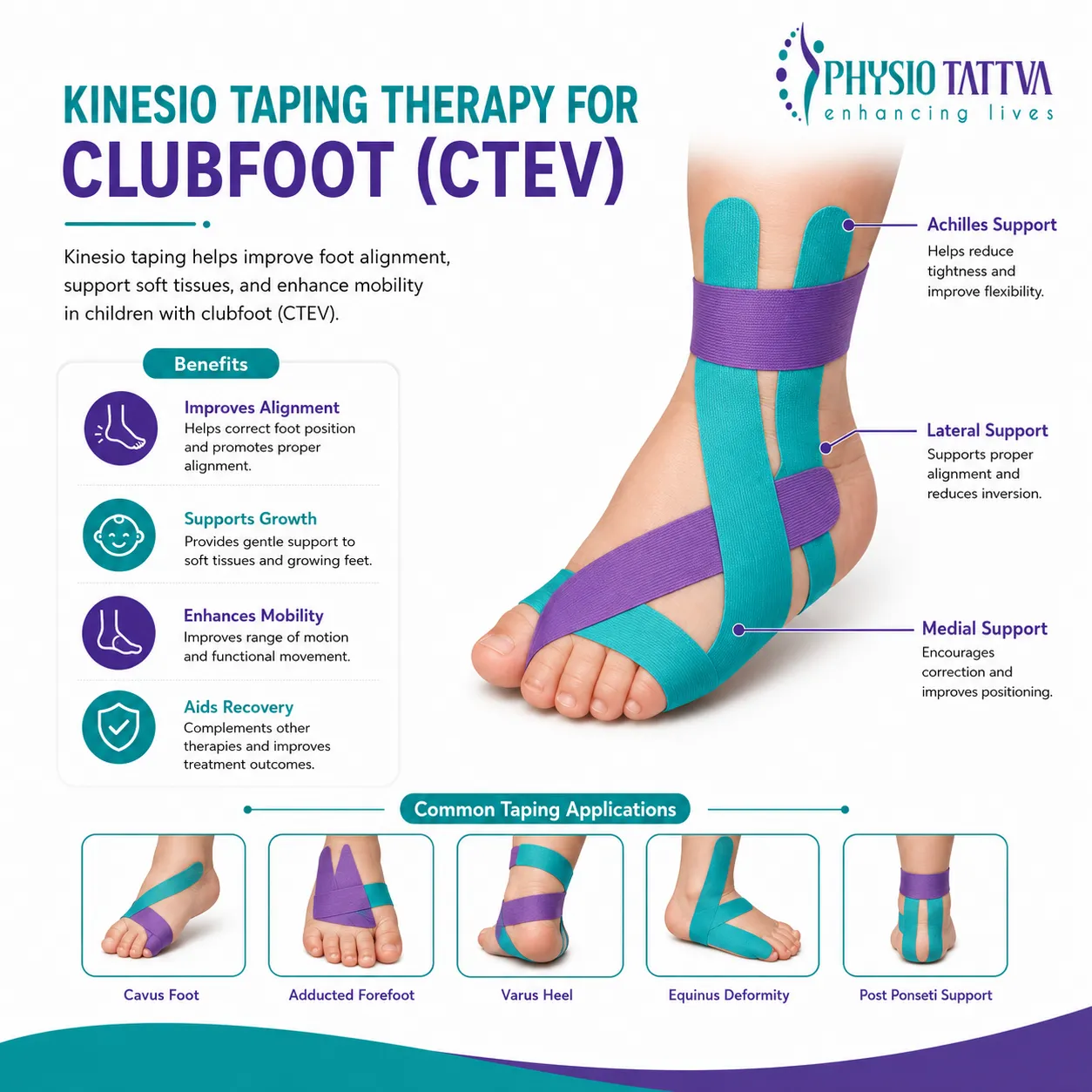
The taping approach is tailored to address the specific elements of the clubfoot deformity, commonly remembered using the CAVE framework: Cavus, Adductus, Varus, and Equinus.
Correcting Forefoot Adductus and Hindfoot Varus
To address inward turning of the forefoot and heel, Kinesio taping is applied in a way that gently guides the foot toward a more neutral alignment:
- Anchor: The tape is often anchored on the inner (medial) side of the foot near the big toe.
- Application: It is then stretched and pulled across the top of the foot and wrapped around the outside (lateral) of the heel and ankle.
- Goal: This line of pull gently encourages the forefoot to abduct (move outward) and the heel to evert (move out of the varus position).
Promoting Dorsiflexion (Correcting Equinus)
When limited upward movement of the foot is present, taping is used to support dorsiflexion and muscle activation:
- Anchor: The tape is anchored on the top (dorsum) of the foot.
- Application: It is then stretched upward along the front of the shin.
- Goal: This facilitates the action of the dorsiflexor muscles (like the tibialis anterior), encouraging the foot to lift upwards.
Supporting the Arch (Correcting Cavus)
A separate strip can be applied under the longitudinal arch to provide gentle lift and support. The therapist will cut the tape to the precise length needed and will apply specific amounts of tension depending on the therapeutic goal (e.g., more tension for correction, less for muscle facilitation).
Benefits and Limitations of Kinesio Taping for Clubfoot
Kinesio taping can be a valuable supportive therapy when used correctly within a structured clubfoot treatment plan. Understanding both its benefits and its limitations helps families make informed decisions and maintain realistic expectations.
Key Benefits of Kinesio Taping for Clubfoot
When applied by a trained pediatric physiotherapist, Kinesio taping offers several important advantages for infants with clubfoot:
- Non-Invasive and Gentle: A painless, child-friendly adjunct to clubfoot treatment.
- Allows Natural Movement: Unlike casts, taping permits active foot movement, supporting healthy muscle development.
- Comfortable for Infants: Lightweight and breathable tape can be worn for 3–5 days, even during bathing.
- Continuous Therapeutic Support: Provides a low-load, prolonged stretch and constant sensory feedback.
- Encourages Parent Involvement: With proper guidance, parents may assist in re-application and become active participants in care.
Limitations and Considerations for Kinesio Taping
Despite its benefits, Kinesio taping also has certain limitations that should be carefully considered:
- Not a Standalone Treatment: It cannot correct rigid clubfoot deformities or replace casting and bracing.
- Requires Professional Expertise: Correct application is essential; improper taping can reduce effectiveness or cause harm.
- Risk of Skin Irritation: Infants have sensitive skin, and incorrect use may lead to redness, blisters, or irritation.
- Limited High-Level Evidence: Clinical experience is encouraging, but large-scale research is still evolving.
- Cost and Access: Tape and therapy sessions may involve additional costs not always covered by insurance.
Supporting Clubfoot (CTEV) Correction with Kinesio Taping at Physiotattva
For Congenital Talipes Equinovarus (CTEV/clubfoot), Kinesio taping serves as a valuable adjunctive therapy. Its primary role is to maintain correction, improve muscle function, and prevent relapse, especially during the crucial bracing phase of the Ponseti method. While it is not a magical cure, when used strategically by a trained pediatric therapist, it can significantly enhance treatment outcomes, support the foot’s dynamic function, and provide parents with an additional tool to ensure the best possible result for their child.
At Physiotattva physiotherapy clinics in Bangalore and Hyderabad, you receive personalised care tailored to your specific needs, ensuring effective results and comfort throughout your journey to recovery.
Don’t wait to start your recovery! Get in touch with Physiotattva for more details! Contact us at +91 89510 47001.
Why Physiotattva?
22+
50,000+
95%
200+
25+
4.8
Cities We Serve

Bangalore
At Physio Tattva, we are committed to bring access to quality physio care through ultra-modern clinics and high-skilled practitioners to all.
.webp)
Hyderabad
At Physio Tattva, we are committed to bring access to quality physio care through ultra-modern clinics and high-skilled practitioners to all.
.webp)
Vishakhapatnam
At Physio Tattva, we are committed to bring access to quality physio care through ultra-modern clinics and high-skilled practitioners to all.
Core Treatments
Core Conditions
Core Symptoms
Frequently Asked Questions
Is Kinesio taping painful for my baby?

Can Kinesio taping cure clubfoot on its own?
How long does the tape stay on a baby's foot?
Are there any side effects of Kinesio taping for infants?
When can my child start Kinesio taping for CTEV?






%20(1)-p-3200.jpeg)


.jpg)
.webp)
.webp)
.webp)