





An Achilles tendon rupture is a serious injury that often requires months of structured rehabilitation following surgical or non-surgical treatment. Given the tendon’s slow healing capacity, there is growing interest in non-invasive therapies that can support and enhance recovery. Pulsed Electromagnetic Fields (PEMF) therapy has emerged as a supportive modality aimed at promoting tissue healing and pain reduction.
This article explores how PEMF therapy works, the available scientific evidence, and its role within a modern Achilles tendon rehabilitation programme.
Understanding the Achilles Tendon Rupture
The Achilles tendon is the largest and strongest tendon in the body, connecting the calf muscles to the heel bone. A rupture occurs when this tendon partially or completely tears, most often due to a sudden, forceful contraction of the calf muscles during high-impact or unexpected movements.
Activities That Commonly Lead to Achilles Tendon Rupture
Achilles tendon ruptures are frequently associated with activities or situations that place sudden stress on the tendon, including:
- “Weekend warrior” sports
- Sudden acceleration or jumping
- Trips, slips, and falls
Standard Treatment Approaches
Management of an Achilles tendon rupture depends on the severity of the tear, activity level, and overall health of the individual. Common treatment options include:
- Surgical Repair: The torn ends of the tendon are sutured back together. This approach is often recommended for active individuals or athletes, as it may reduce the risk of re-rupture and support a stronger repair.
- Conservative (Non-Surgical) Management: The foot is immobilised in a cast or walking boot with the toes pointed downward to bring the tendon ends closer together, allowing natural healing over time.
The Healing Challenge
Achilles tendon healing can be slow and complex due to its relatively limited blood supply compared to muscle tissue. As a result, the repaired tendon may become thicker with scar tissue, weaker, and less flexible, increasing the risk of stiffness, reduced performance, and future injury without proper rehabilitation.
What is Pulsed Electromagnetic Fields (PEMF) Therapy?
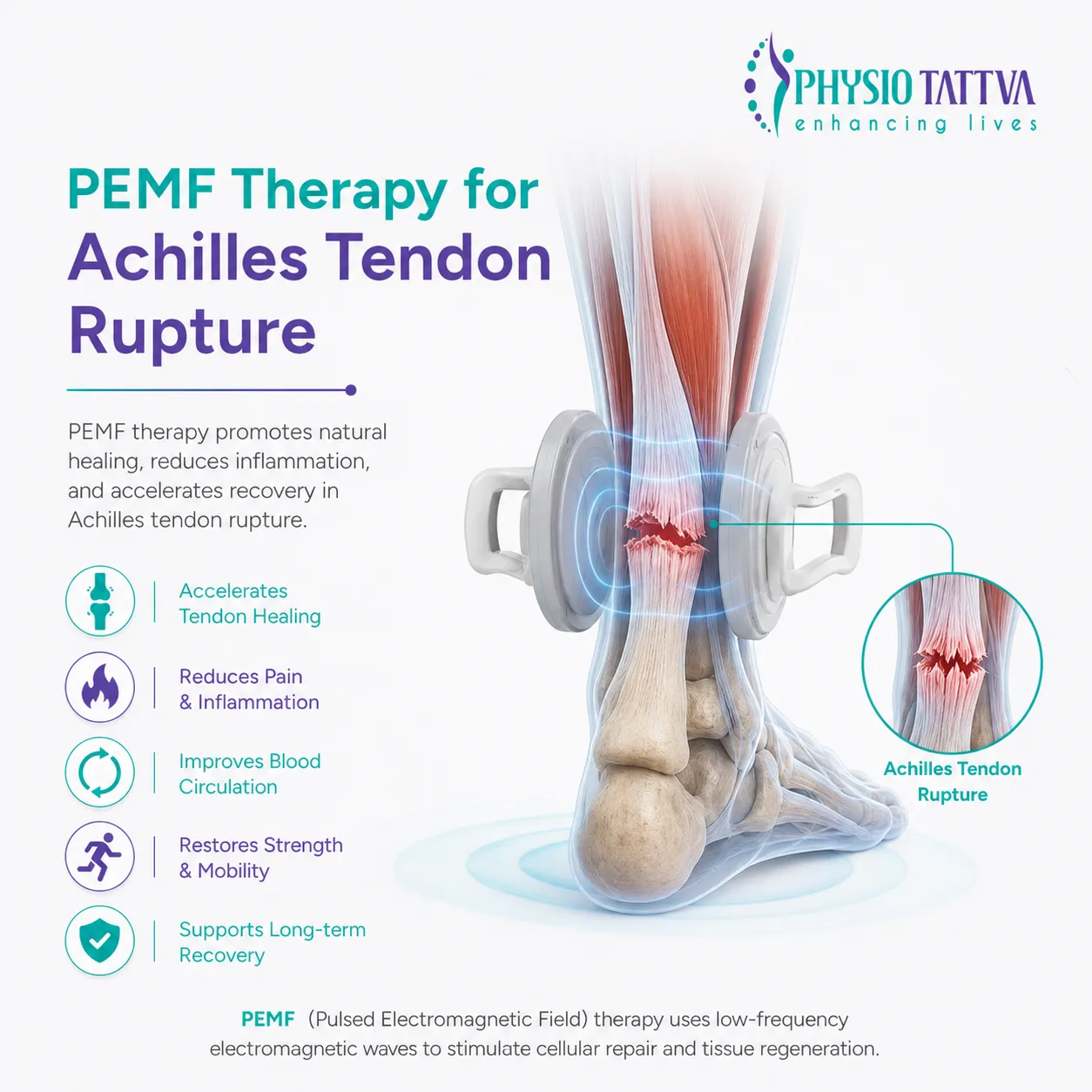
PEMF therapy is a non-invasive treatment that uses low-frequency, short-duration magnetic pulses to stimulate and energize cells. Unlike the harmful electromagnetic fields from power lines or microwaves, the fields used in PEMF are safe and specifically tuned to frequencies that mimic the body's natural electrical signals to promote healing.
The therapy is typically administered through a device with a coil or applicator that is placed over the injured area (in this case, the lower leg and ankle). These pulses penetrate deep into the tissue, including bone, muscle, and tendon, without generating heat.
How PEMF May Help Heal an Achilles Tendon: The Scientific Mechanism
The primary goal of using PEMF for an Achilles tendon rupture is to accelerate and improve the quality of the natural healing process. It works at a cellular level through several proposed mechanisms:
- Cellular Stimulation: PEMF pulses are thought to stimulate ion flow (like calcium and potassium) across the cell membrane. This recharges the cell's electrical potential, improving its ability to function, repair, and replicate.
- Enhanced Blood Flow (Angiogenesis): The therapy may promote the formation of new blood vessels. For a poorly vascularized tissue like a tendon, improved blood flow is critical for delivering oxygen, nutrients, and healing factors to the injury site.
- Stimulation of Collagen Synthesis: The Achilles tendon is primarily composed of Type I collagen. Studies suggest that PEMF can upregulate the production of growth factors (like TGF-β1) that stimulate tenocytes (tendon cells) to produce more and better-organised collagen fibers. This leads to a stronger, more structurally sound repair.
- Anti-Inflammatory Effects: While inflammation is a necessary part of early healing, chronic or excessive inflammation can impede recovery and lead to pain and swelling. PEMF has been shown to reduce pro-inflammatory markers, helping to manage swelling and pain, particularly in the acute and sub-acute phases post-injury.
- Pain Reduction: PEMF may help reduce pain by increasing endorphin levels and modulating the pain signals sent to the brain.
What Does the Research Say About PEMF Therapy?
While large-scale human trials specifically on PEMF for acute Achilles tendon ruptures are still emerging, a growing body of evidence supports its use for general tendon healing and soft tissue injuries.
- Animal Studies: Research on animal models with tendon injuries has shown that PEMF treatment can lead to tendons with greater tensile strength, more organised collagen alignment, and faster maturation of the healing tissue compared to control groups.
- Tendonitis and Other Tendinopathies: Studies on conditions like rotator cuff tendonitis and tennis elbow have demonstrated that PEMF can reduce pain and improve function. The biological principles of healing in these conditions are highly relevant to an Achilles rupture.
- Post-Operative Use: PEMF is often used post-surgically to reduce swelling, manage pain, and accelerate the integration of repaired tissue. After an Achilles repair surgery, it can be applied directly over the cast or boot.
It is crucial to note that PEMF is not a standalone cure. It is an adjunctive therapy, meaning it works best when integrated into a comprehensive rehabilitation program designed by a physical therapist.
Integrating PEMF into Your Achilles Rupture Recovery Plan
PEMF therapy is most effective when used in a structured rehabilitation programme rather than used in isolation. Its flexibility and non-invasive nature allow it to be applied across different stages of Achilles tendon rupture recovery, supporting tissue healing, pain management, and inflammation control alongside standard surgical or conservative treatment and physiotherapy.
- Initial Phase (Immobilisation): PEMF can be used while the leg is still in a cast or boot. Its ability to penetrate these materials makes it ideal for stimulating healing from day one, helping to reduce swelling and lay down a healthy collagen matrix.
- Rehabilitation Phase (Physical Therapy): As you begin weight-bearing and movement exercises, PEMF can be used before or after physical therapy sessions.
- Pre-Therapy: Can help "prime" the tissue, increase blood flow, and potentially reduce pain during exercises.
- Post-Therapy: Can help manage any post-exercise inflammation and support tissue repair overnight.
- Device & Protocol: A typical protocol involves daily sessions of 20-60 minutes. The device may be a localized applicator wrapped around the ankle or a mat that the patient lies on.
Key Benefits and Considerations
While PEMF therapy shows promise in supporting Achilles tendon rupture recovery, understanding both its benefits and limitations is essential. Reviewing these aspects helps patients and clinicians decide how PEMF can be safely and effectively incorporated into a comprehensive rehabilitation strategy.
Benefits of PEMF Therapy in Achilles Tendon Healing
When used appropriately alongside standard rehabilitation, PEMF therapy may offer several supportive benefits during the healing process:
- Accelerated Healing Timeline: May shorten the overall recovery period.
- Improved Repair Quality: Promotes stronger and more organized tendon tissue, potentially reducing the risk of re-rupture.
- Reduced Pain and Swelling: Provides a non-pharmacological way to manage symptoms.
- Completely Non-Invasive and Safe: No known significant side effects when used correctly.
Limitations and Safety Considerations of PEMF Therapy
Despite its potential advantages, PEMF therapy is not suitable for everyone and should be used with appropriate clinical guidance:
- Contraindications: PEMF should not be used by individuals with pacemakers, implanted pain modulators, or cochlear implants. It is also not recommended during pregnancy.
- Evidence is Still Growing: While promising, it is not yet a universal standard of care.
- Cost and Accessibility: PEMF devices can be expensive to purchase or rent, and treatment is not always covered by insurance.
- Not a Standalone Solution: Success depends on consistent use as part of a structured rehabilitation plan that includes appropriate rest, nutrition, and physical therapy.
Advanced Achilles Rehabilitation with PEMF Therapy at Physiotattva
Recovering from an Achilles tendon rupture is a gradual process that requires patience, structured rehabilitation, and the right therapeutic support. PEMF therapy offers a promising, non-invasive approach to complement standard surgical or conservative treatment by supporting cellular healing, improving circulation, reducing inflammation, and encouraging healthy collagen formation. When used alongside physiotherapy and guided medical care, PEMF can play a valuable role in enhancing recovery quality. Consulting an orthopaedic specialist or physiotherapist can help determine whether PEMF therapy is an appropriate addition to your personalised rehabilitation plan.
At Physiotattva physiotherapy clinics in Bangalore, Hyderabad, and Vizag you receive personalised care tailored to your specific needs, ensuring effective results and comfort throughout your journey to recovery.
Don’t wait to start your recovery! Get in touch with Physiotattva for more details! Contact us at +91 89510 47001.
Why Physiotattva?
22+
50,000+
95%
200+
25+
4.8
Cities We Serve

Bangalore
At Physio Tattva, we are committed to bring access to quality physio care through ultra-modern clinics and high-skilled practitioners to all.
.webp)
Hyderabad
At Physio Tattva, we are committed to bring access to quality physio care through ultra-modern clinics and high-skilled practitioners to all.
.webp)
Vishakhapatnam
At Physio Tattva, we are committed to bring access to quality physio care through ultra-modern clinics and high-skilled practitioners to all.
Core Treatments
Core Conditions
Core Symptoms
Frequently Asked Questions
What is pulsed electromagnetic fields (PEMF) therapy?

How does PEMF therapy help with an Achilles tendon rupture?
Can PEMF therapy replace surgery or physical therapy for an Achilles rupture?
Is PEMF therapy safe, and does it hurt?
What does a typical PEMF treatment session for the Achilles tendon involve?






%20(1)-p-3200.jpeg)
.jpg)
.webp)
.webp)
.webp)